
Prepared by:
Zuha Iftikhar (G14)
Warda Mehmood (G15)
Asma Shafique (G15)
Compiled by:
Hafiz Muhammad Umair Noor (G12)
Recommended Books:
- Snell’s Clinical Anatomy by Regions 10th Edition
- BD Chaurasia Human Anatomy 8th Edition
LOWER LIMB
Important:
- All Muscles along with their nerve innervation, actions from Tables in Snell’s. You should do the tables compartment wise for retaining them well, not all at once.
- But the correct sequence for the first time is to do Bones first with proper muscle attachments, ligaments. landmarks and then move to Muscle Tables.
- For nerves and blood supply, make your own flow charts or on sticky notes for quick revision.
- Anatomy can be mastered if you visualize things more rather than simply cramming it again on loop. Prefer Visual Image Memory along with mnemonics, you will master it, Insha’Allah. Trust the process, once you do it, you’ll know that things are interconnected.
Sequence that should be preferred:
Bones: (from BD)
- How to do it?
- Take the Lecture of Bone you are going to do. The lecture should be the one in which they are teaching you through 3D animation or through real bone.
- Memorize along with the lecture, prefer to issue Bones from your museum and learn by holding bone along with Lecture & memorize along with it.It is Important as in Proffs models and real bones can be asked as well as diagrams from Snell’s (In Last proff , pictures were given both of bony attachments + landmarks)
- After Lecture, repeat all the landmarks, muscle and ligament attachments by yourself on the bone, or teach some other fellow of yours (choose any option as per your convenience).
- After that Read BD (don’t start to memorize each line as it is quite extensive), you already have mastered the bone now, if some points are left, Mark those and every time you revise the bone again you will only read those different points only.
- Which Lectures to take for Bone?
- Johari MBBS ( as it is according to BD ), & some other Indian tutors, teaching through real bone or 3D animation.
- Bone Sequence:
- Hip Bone ( IMP ) Asked in Proff OSPE and in Block internal as well.
- Femur ( IMP ) , Asked in Proff OSPE .
- Tibia ( IMP ), asked in Proff OSPE and Block Internal as well.
- Fibula ( It is less important than others , and is a tricky one as well) Do Landmarks properly at least and side determination.
- Rest do the names of bones of foot and side determination of bones i.e talus , navicular , calcaneus etc, should know how to locate them on pictures and radiographs.
- Learn through real bone or 3D animation.
- Clinicals of Bone:
- And don’t skip clinicals from SNELLS. You must do all clinicals from SNELLS. (also can do from PDF shared)
- For OSPE:
- SNELL diagrams and real bones should be done ( Any of them might come at your stations)
- Questions at OSPE stations i.e. Locate the origin of Hamstring Muscles on the bone , locate tibial tuberosity (Real Bone Infront) ? Name the Part. Or Hold the Bone in the correct way ( Proper side determination) and tell this Bone is of which side. etc.
- On pictures, they may ask for labelling or you have to locate the certain thing asked on pictures .
- SO, You must do the bone properly.
- SNELL diagrams and real bones should be done ( Any of them might come at your stations)
Muscles:
- Do all Muscle Tables from SNELLS, Proper Nerve Supply, Origin and Insertion , Muscles of each compartment and their Action.
- Muscle Tables are the base of your concepts, Memorize it again and again , Understand it Properly. Remember it by using College Models Because in Proff OSPE , Muscles can be asked on Models or pictures are given.
- Nerve Supply and actions along with origin & insertion are asked in MCQs.
- Muscles of Sole of Foot (Names very important Layer wise , Nerve Supply & Action) are Important Diagrams for OSPE (v.imp)
Joints: (from Snells)
- How to do it?
- For Joints , you have to first understand the anatomy, Bones Involved, type of Joint they are making, Blood supply , Nerves passing through it (innervation) and very very important Ligaments, Holding it together.
- For Anatomy , Take Lecture of it first, Ligaments are very Important in Joints
- After that, Movement of Joints and the Muscles involved in those movements.
- And then Clinicals of Joints.
- Joints Sequence:
- Hip Joint (IMP):
- Type, Articular surfaces, ligaments Important ( their Number and Names and their description as well)
- Relations are not Important Just Read it once.
- Blood Supply, Nerve Supply & Movements( and muscles producing ) are important.
- Clinicals SNELLS . ( IMP )
- Knee Joint (MOST IMP):
- Do it from SNELLS, it is written Better there.
- Type, Capsule, ligaments ( Important ) Extracapsular & Intracapsular.
- Menisci (their Clinicals Are more important)
- Synovial membrane, Bursa ( their number, Location)
- Nerve supply & Blood supply.
- Movements ( Most Important ) Locking & Unlocking of Knee Joint and role of muscles in it( Very IMP Viva Qs and as well as Important for writtens ) clear its concept from youtube.
- Clinicals from SNELLS
- Ankle Joint
- From Snells
- Ligaments are Important in it, Medial or deltoid ligament often asked in viva. And important for MCQs as well.
- Type & Movements . Do it properly.
- Rest Do all Remaining Joints from SNELLS, Only Types & Movements, Ligaments(Names).
- Hip Joint (IMP):
- Clinicals of Joints:
- Do Clinicals from SNELLS &PDF shared.
Now, Start Compartment wise study from SNELLS CHAPTER:11, and some topics are also covered in BD. Switching guidelines between both books are for your best preparation and to cover your learning objectives thoroughly.
ANTERIOR Compartment of Thigh
- Facia (read)
- Only Deep facia and it’s modification (iliotibial tract , saphenous opening and septa) from BD chap:3
- Cutaneous Nerves (understand them well with the help of diagram given)
- Cutaneous veins (If you do it Here , Base will be made and you will be able to comprehend easily in upcoming topics )
- Inguinal Lymph Nodes both superficial and deep (will have better understanding after doing lymphatics of lower limb)
- Above 3 topics are easy to understand after studying upcoming topics so don’t get confused.( can do at last)
- Bursas (Names Important from BD and their clinicals)
- Femoral Triangle ( Boundaries, Content) ,Femoral Sheath and Femoral Canal VERY IMP topics
- Adductor’s ( Subsartorial/Hunters) canal boundaries and contents IMP
- BLOOD and NERVE SUPPLY:
- Femoral artery complete
- Femoral vein complete
- Femoral nerve complete
- Understand the course and origin and visualise it , through animations or 3D apps or Use Netter Atlas for it.
- Make a flow chart of their course on sticky note and attach it , it will be easy to comprehend
MEDIAL Compartment of Thigh
- As you have already done muscles from Muscle Tables
BLOOD and NERVE SUPPLY:
- Profunda femoris artery complete( origin, course , branches ) , vein and obturator artery and vein.
- Obturator nerve ( course , branches) complete
GLUTEAL Region
- As you have already done muscles from Muscle Tables..
- Skin and facia ( read once not imp)
- Ligaments ( sacrospinous and sacrotuberous) and foramina (Structures passing through Greater & Lesser Sciatic foramen (IMP for written & Viva )
- Structures under cover of gluteus Maximus ( Ligaments , Bursa ) Past Paper Qs do from BD chap:5
- NERVES:
Sciatic nerve complete course can be done only after completing lower limb so make it’s flow chart at the end when you’re done with all.(better do it from BD) clinicals imp
Give a good read to all nerves mentioned and learn to which muscles they supply.
- Blood supply:
Gluteal arteries read complete (supply to which muscles)
Trochanteric and cruciate anastomosis (IMP)
Mnemonics: trochanteric:SLIM , cruciate:LIMP
- Structures passing through Greater & Lesser Sciatic foramen (IMP for written & Viva )
Popliteal Fossa (Do it complete From BD Chap:6)
- Popliteal Fossa Complete ( Very IMP for written & Viva )
- Nerves and Arteries As mentioned above as well ( Sticky Note Technique)
- Anastomosis of Knee Joint ( Very IMP for written , Past Block Qs) Understand with the help of diagram.
POSTERIOR Compartment of Thigh
- Muscles first as you do always.
- Nerves As mentioned above as well ( Sticky Note Technique) Or You can do it from SNELLS (compartmentwise) and Arteries ( Anastomosis of Back of Thigh is Important Bd chap:7 pg 102 )
- Do All Clinicals side by side.
LEG
- ANTERIOR comp:
Muscles table, Anterior tibial artery and deep peroneal nerve complete from snells ( make notes for easy revision)
- LATERAL comp:
Muscles table, blood supply and nerve supply complete
- POSTERIOR comp:
Muscles tables, blood and nerve supply ( Post. Tibial artery and tibial nerve) complete , achilles tendon
RETINACULAS (from BD)
- (Very IMP)
- Retinacula written in Deep Fascia Topic.
- From BD chap 8 :
1) Extensor Retinaculum Complete ( Very IMP ) There are mnemonics to memorise it. do use those mnemonics. As these are often asked in viva stations and important for written as well. (Tall Husbands Are Never Dear Person )
2) peroneal retinaculum
- From BD chap 9 : Flexor retinaculum Complete. Learn it through the mnemonic as well. And do learn it by visualising it will be in long term memory then. (Tina Deserves ANice Husband )
- Planter Aponeurosis from BD Chap 10
- All Nerves and all Arteries As mentioned above as well ( Sticky Note Technique) can do it from SNELLS (compartmentwise)
- Tendons of Thigh from BD( Important Viva Qs )
- Do All Clinicals side by side.
Chapter 11: (BD)
- Venous drainage (vv imp) table 11.1, Clinicals imp
- Lymphatic drainage try to do in flow chart ( will share it too)
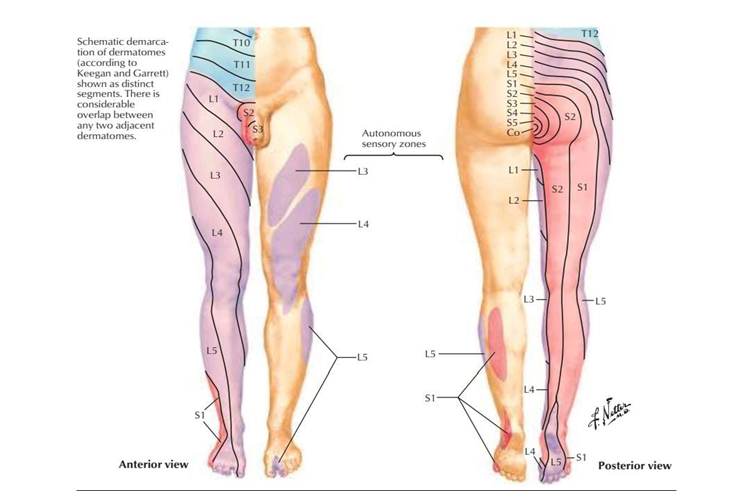
Dermatomes:
- Do definition + diagram from netters atlas ( given below ) , this topic is in your LO’s ( questions used to come to draw it in SEQ) but now understand it only
Foot:
- Fibrous flexor sheath, extensor expansion ,and synovial flexor sheath ( Read these topics from Snells.)
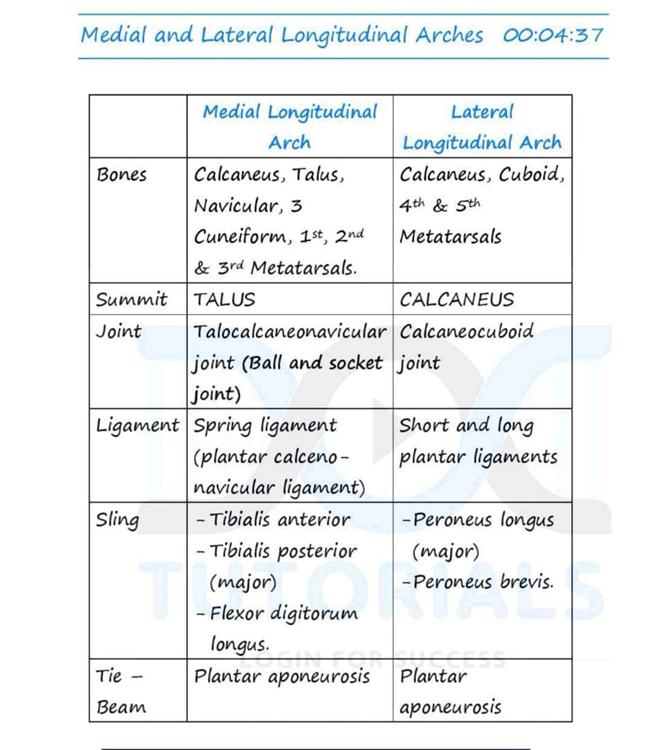
- Do the ARCHES from SNELLS, It is very well written in it., It is an Important Topic. Do it completely from Snells. Its. Clinicals are important.
- READ this table too:
- Names of Muscles of foot ( each layer)from snells table + their nerve supply and action ( its diagrams are very important for ospe) ,
- BLOOD Supply : Dorsalis Pedis artery ( v. imp for both written and VIVA) , for sole lateral and medial planter arteries.
Arteries and Nerves:
- You can revise Nerves and Arteries after doing Chapterwise & Compartmentwise from Appendix at the End of BD
- Sacral plexus page 100 and lumber plexus page 47of snells ( although not as much imp ) but as they are in your LO’s so do them.
- I would recommend you to make your own notes of flowcharts of Neurovascular supply for better grip.
Stay consistent. Best wishes.
That’s all from my side. Anatomy is a distinguishing subject, if you master this, you are ahead of many just because of it. Best Wishes!
Recommended YOUTUBE CHANNELS :
Dr Adel Bondok , Angelina Isaac , Dr Azam ( you can take LECTURES from any one of them according to your choice)