
Prepared by:
Harram Sameer (G15)
Compiled by:
Hafiz Muhammad Umair Noor (G12)
Reference Books:
- Lippincott Illustrated Reviews: Biochemistry 8th Edition
- Harper’s Illustrated Biochemistry 30th Edition
- Satyanarayana Biochemistry 6th Edition
- Essential of Medical Biochemistry by Mushtaq Ahmed 9th edition
Cell: (F-B-001, F-B-002)
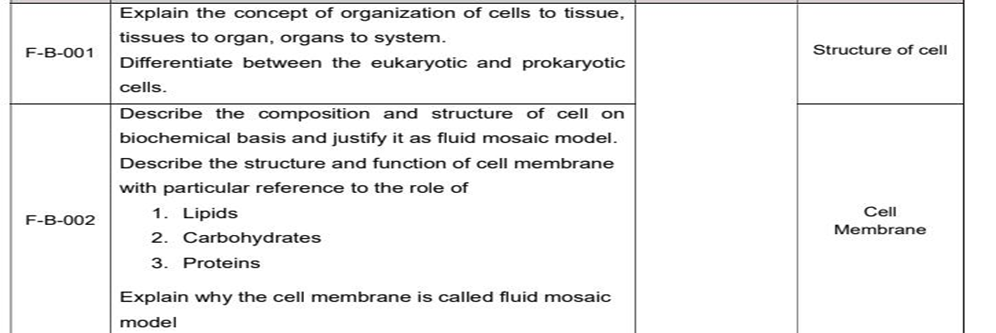
- These LOs of cell will be automatically covered if you have prepared chap 2 of physio and histo
- But if you want to prepare these LOs from biochem as well , then prepare these LOs from Satya Chap 1 or any short book ( In unravelled, extensive detail of organelles is also given which isn’t required according to the LOs)
Cell Diseases:
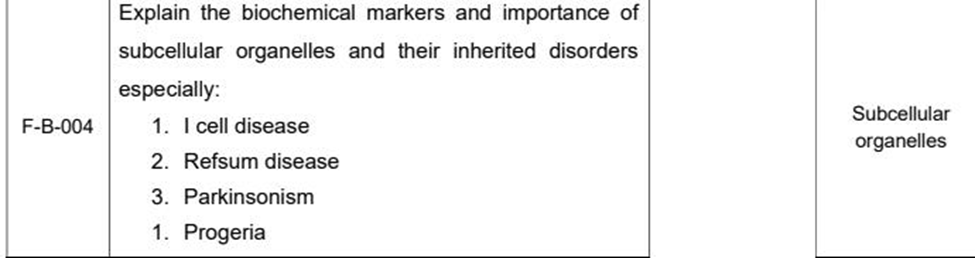
- Do the Biochemical markers and Subcellular organelles’ diseases from medico express , unravelled or from the pics shared below ( it is preferable to do cell diseases from medico express or unravelled as in the pics given below , the diseases are written very briefly )


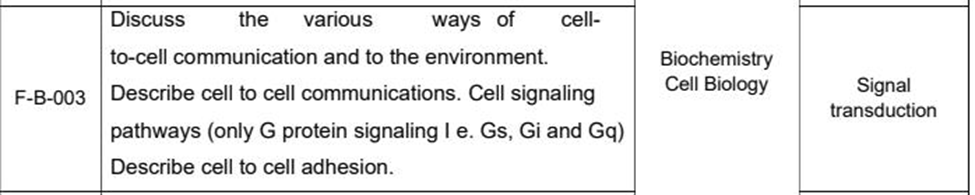
Signal Transduction: (F-B-003)
Lecture: Selfless Medicose for GPCRS
For Cell junctions Dr Bhanu Prakash or Ninja Nerd
- LO 1: Ways of cell to cell communication and to environment from medico express or unravelled, Also do fig 8.5 and 8.6 from Lippincott chap 8
- LO 3: Cell Adhesion from any short book or AI, can also be done from histo chap 2
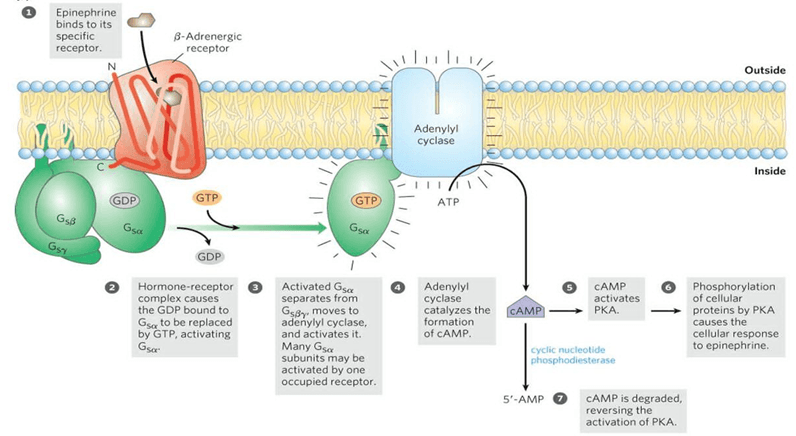
- LO 2: GPCRs from Lippincott chap 8
- Do fig 8.7, 8.8 (Also do theory of GPCRs from Pg 103, 104 ,105) & Fig 17.8 (It is in chap 17, do only the figure)
- Also do The side box of vibrio cholera and whooping cough (important)
- Def of signal transduction and importance/ uses of G protein coupled receptors , pics are shared below :



Tidbits:
- Signal Transduction: process by which physical or chemical signals are transmitted through cell as a series of molecular events, particularly phosphorylation by protein kinases.
- Intracellular signals
- Extracellular signals
- Juxtacrine Signaling: signaling that requires close contact, a ligand on one surface attaches to receptor on the other. By secreting molecules:
- Endocrine (in blood)
- Paracrine (to nearby cells)
- Synaptic (through synapses)
- Autocrine (to cells own self)
DNA & RNA: (F-B-006, F-B-007)


Lecture: Njoy Biochem
DNA:
- Prepare these LOs of DNA from Lippincott chap 30 ( given in the start of chap under DNA structure )or from Satya chap 5
- Most imp topics from Satya chapter 5 are given below:
- Chargaff’s Rule and DNA double helix
- Different forms of DNA (A, B & Z) ( can also be done from lippin chap 30)
- Names of other types of DNA structures (Bent, triple stranded etc.)
- Organization of DNA along with diagram
- Definition of melting temp and renaturation
RNA:

- LO 1: From Satya chap 5 or lippin chap 31
- LO 2: Structure and Function of Different types of RNAs from Satya chap 5 or lippin chap 31 (It is preferable to do RNA from Satya chap 5)
- LO 3: Functions of various small RNAs present in cell from Satya chap 5 table 5.3
- Focus on everything under topic of RNA given in Satya chap 5
tRNA has an unusual base , dihydrouracil in its structure
Nucleotides: (F-B-005, F-B-008)


Lectures: TN med zone, Njoy biochem or Awesome Biochemistry
- These LOs can be done from Satya chap 5 ( Mostly students cover these LOs from Satya chap 5) or from Chatterjea chap 14
- Do biomedical importance of natural and synthetic analogues from Satya chapter 5 (Purine, Pyrimidine and Nucleotide Analogs topic) as well as look at minor bases found in nucleic acids
Chromosome: (F-B-009)

LO 1: Do higher organization of DNA from Lippincott chapter 30 page 473, 474 (eukaryotic DNA organization)
- Also refer to the diagram below
LO 2: Difference:
- DNA: DNA (deoxyribonucleic acid) is the molecule that carries the genetic instructions for an organism.
- Chromatin: DNA is packaged with proteins (like histones) to form a complex called chromatin.
- Chromosome: A chromosome is a structure made up of DNA and proteins, where DNA is tightly coiled and packaged.
- Chromatid: Before cell division, a chromosome replicates, resulting in two identical copies called sister chromatids. These sister chromatids are joined at a region called the centromere.
- Cell Division: During cell division (mitosis or meiosis), the sister chromatids separate, and each becomes an individual chromosome in the daughter cells.
- Analogy: Think of a chromosome as a “house” and the chromatids as the two identical “floors” of that house.

Enzymes: (F-B-010)
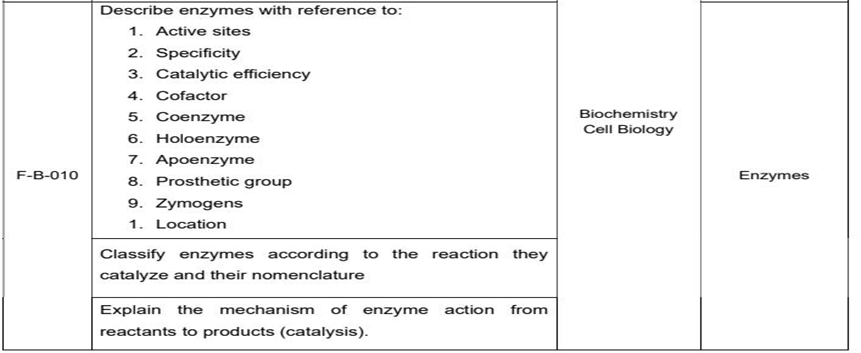
Lectures: Best channel for concept of enzymes is Medicosis Perfectionalis on Youtube especially for enzyme inhibition
Other channels for enzymes include Rajesh Jambhulkar, Njoy biochem and awesome biochem
LO 1: Do enzymes with reference to active site, specificity etc. from Lippincott chapter 5 , given under the heading of Properties of Enzymes ( only zymogen isn’t explained, you can do it from any short book)
LO 2: Do nomenclature from Lippincott chapter 5
Do classification of enzymes from Lippincott fig 5.1 (keep in mind a new 7th class of enzymes Translocases) , subclasses from Mushtaq
LO 3: Do Mechanism of action from lippin chap 5
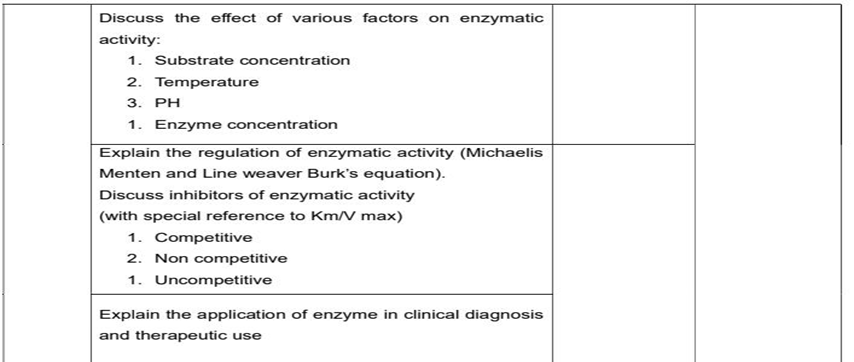
LO 4: Factors affecting enzymatic activity from lippin chap 5
LO 5: Michealis Menten Kinetics, Lineweaver Burk plot and Competitive and Non-competitive inhibition from Lippincott chapter 5
- Fig 5.12 and 5.14 are vvvv imp
- Do Uncompetitive Inhibition of enzymes from Mushtaq chapter 6 and Medicosis Perfectionalis
- Leave the topic of Enzyme Regulation as it is not mentioned in the syllabus
LO 6: Do therapeutic use of enzymes from Satya table 6.8
Some topics aren’t mentioned in Los but they’re very important, so it is better to do them. These are :
- For enzymes used in clinical diagnostics Do Lippincott table 5.2
- Also do isozymes from lippin page 70
- Do table 6.1 and 6.6 to 6.13 from Satya
- Regulation of enzymes by covalent modification from lippin chap 5
Amino acids: (F-B-011)
Lectures: Njoy Biochem, Rajesh Jambhulkar, Awesome biochem or Dirty Medicine
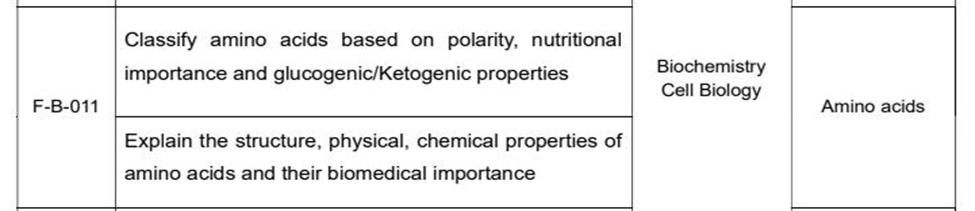
LO 1: Do classification of amino acids based on polarity from Lippincott fig 1.2 and 1.3
- Do structural classification from Satya chapter 4 page 46 to 51 (skip polarity based classification from Satya as it is wrong)
- Do classification on basis of nutritional importance ( essential and non essential amino acids)and glucogenic and ketogenic properties from Lippincott fig 20.2
- Do conditionally important amino acids from Satya chap 4
LO 2: Do structure , physical and chemical properties of amino acids from Satya chapter 4
- Do biomedical importance of amino acids from Satya chapter 4 page 55
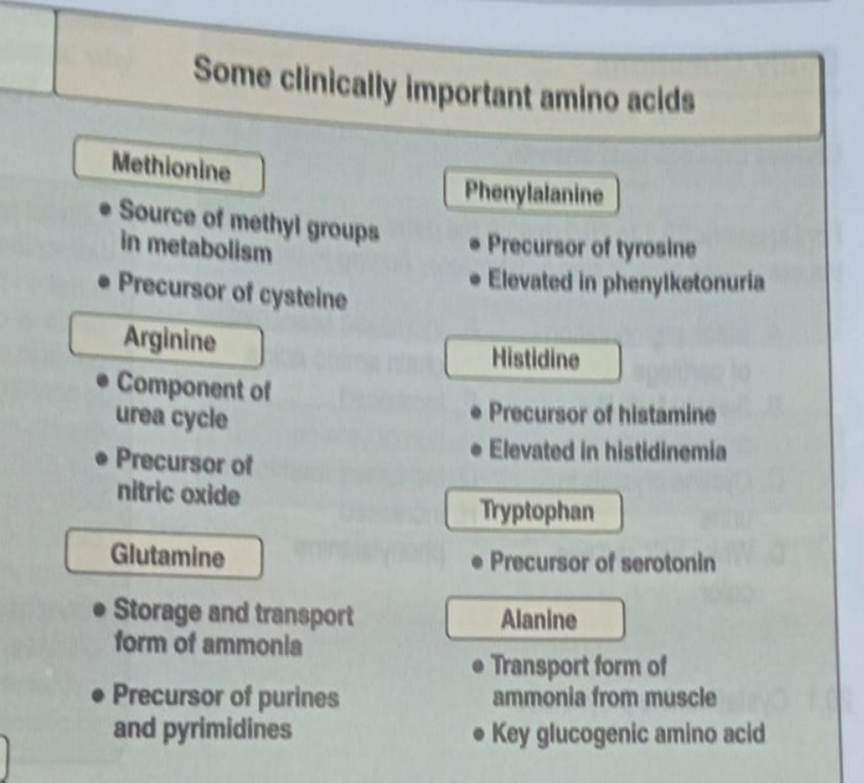
- Do functions of individual amino acids from the pic shared below (pic reference Lippincott chapter 20 page 305 summary)
Note: If there’s any conflict between the classifications on Lippincott and Satya, prefer Lippincott
Protein: (F-B-012)
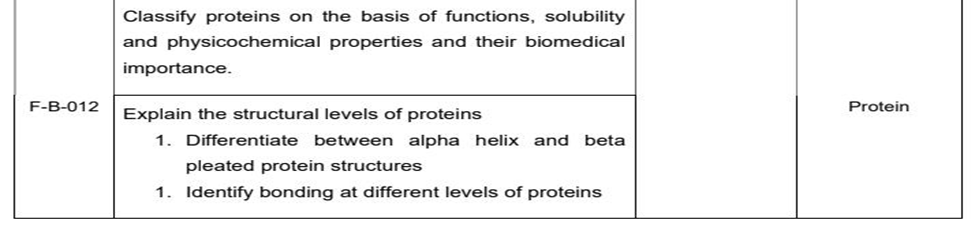

LO 1: Do classification of proteins from Satya chapter 4
- Do biomedical importance of proteins from Satya chapter 4 (biologically imp peptides)
- Class A and B proteins from any short book or AI
LO 2 : Do Structural levels of proteins from Lippincott chap 2 ( complete chap )
- You should be very clear about the difference in alpha helix and beta pleated sheets, the types of stabilizing interactions between proteins at each level, examples of each structural level.
LO 3 :Do the Role Of Chaperones from chap 2 page 21, Lippincott ( It is under the topic of tertiary structure of proteins)
LO 4: Do biochemical basis of disorders of proteins misfolding and
Alzheimer’s and prion’s disease from Lippincott chapter 2
- You should be very clear about the biochemical basis of diseases , e.g
Biochemical basis of Alzheimer’s: It is a deposition of amyloid beta plaques in brain parenchyma. (The simpler, the better)
Plasma Proteins: (F-B-013)

Lectures : Rajesh Jambhulkar or Medicose Perfectionalis
- Do plasma proteins from Satya chapter 9
- Remember the class of plasma proteins e.g. transferrin is a beta globulin
Immunoglobulins: (F-B-014)
Lectures: For structure of Antibodies —-Dirty Medicine
For Multiple Myeloma ——–Rhesus Medicine or Medicosis
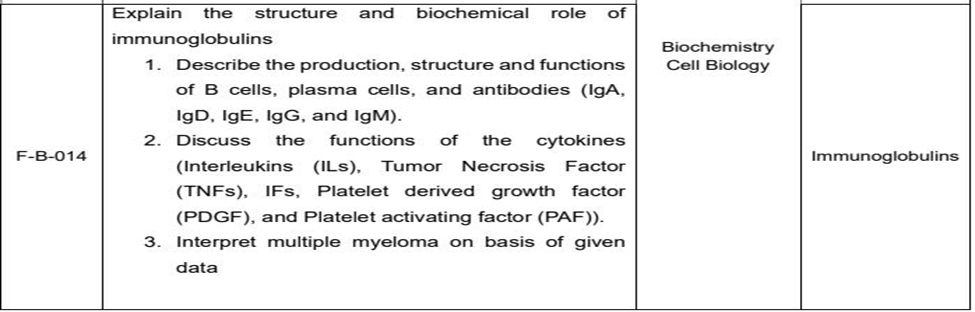
LO 1: Do structure and biomedical importance of immunoglobulins from Satya chapter 9
- Do functions of immunoglobulins from Satya chapter 9
LO 2: Production, structure and function of plasma cells, b cells is covered in Guyton chp 35. Do it from there or from any short book
LO 3: Do interleukins from Guyton chp 35 pg 467 “ Specific regulatory functions of lymphokines’’ and table 35.1.
- Platelet Activating Factor (PAF) from Guyton pg 478 first paragraph.
- PDGF from Guyton pg 477 first paragraph point no. 6
- You can also do this LO from any short book
LO 4: Do multiple myeloma from Satya chapter 9
- Labs for interpretation of multiple myeloma:
- M spike in electrophoretic pattern of serum proteins (Also keep in mind the normal electrophoretic pattern)
- Bence Jones proteins in urine
- Raised plasma immunoglobulin levels
Pro Tip: You can make your own notes for plasma proteins and immunoglobulins by combining all the relevant information from biochem and physio while preparing for block. These notes will be your go to resource for quick rev during proff and it will save a lot of your time. However, it is not advisable to get yourself busy making notes during the proff days.
Also do the mcqs given in the exercise of the chapters of Lippincott included in your syllabus, those mcqs were also asked in our proff