Prepared by:
Zuha Iftikhar (G14)
Khansa Noor (G15)
Compiled by:
Hafiz Muhammad Umair Noor (G12)
UHS 1st Block
(Module No 01)
Reference Book:
- Langman Medical Embryology 14th Edition (Latest)
Some Integrations:
- KLM
Learning Objectives:
- These are Mentioned as per the Latest UHS Curriculum of Session 2025-2026
Lecture videos: For lectures, you can watch medico visuals or ninja nerd videos for better understanding. For simple explanation of langman book or revision, you can go for brainless medicos.
Chapter 1: (LO-F-A-038)
- Do not need to do this chapter as nothing from this is mentioned in your LO’s.
Chapter 2: (LO-F-A-010,011,012,013,014)
- Primordial Germ Cells
- Clinical correlate Teratomas (pg.14)
- Chromosome theory of Inheritance (just give Read )
- Mitosis/Meiosis (You already know about it, Just Do it as Mentioned in Learning Objectives, Difference form)
- Result of meiotic divisions (important)
Clinical correlates from pg #17-24 are very important.
- Numerical Abnormalities (Important)
- Important terms: i) Euploid ii) Aneuploid iii) Trisomy iv) Monosomy v) Nondisjunction vi) Translocations (Do it for MCQ POV)
- Trisomy 21 Down Syndrome (You have to do all the clinical Presentations , Make sure to Memories them through visual Image, these are mostly asked in OSPE) Do Definition /concept of Mosaicism given in it. (imp). Figure 2.7 and 2.8 is also asked in OSPE, so also go through it)
- Trisomy 18, Trisomy 13, Turner Syndrome, Triple X syndrome ( Clinical presentations through visual Image, they are given in OSPE with diagram to identify the syndrome)
- Klinefelter Syndrome (Annual system Past Paper SEQ)
- Do All abnormalities for Scenario-Based SEQ & MCQs
- Structural Abnormalities (Important)
- Cri-du-chat Syndrome, Angelman Syndrome very Important, Prader-Willi Syndrome Very important, Miller Dieker Syndrome, Fragile X Syndrome
- Do Remember which Chromosome is involved in a Particular Abnormality for MCQs
- Important Terms(pg#25) : i) Deletion ii) Microdeletion iii) Fragile Sites iv) Genomic Imprinting (Viva Qs) Do these for MCQ POV just
- Cri-du-chat Syndrome, Angelman Syndrome very Important, Prader-Willi Syndrome Very important, Miller Dieker Syndrome, Fragile X Syndrome
- Gene Mutations:
- Just Remember these terms: i) Single Gene Mutation (only definition) +dominant and recessive mutation
- ii) Mosaicism (pg. 19)
- Diagnostic Techniques (not important Just Do the Names only)
- Oogenesis* Important Do complete till End
- Prenatal= before Birth, Postnatal= At puberty/After Birth (You can do these Topics from KLM as well if you want, otherwise Langman is Good to Go)
- Spermatogenesis* Important Do complete till End
For oogenesis and spermatogenesis, lectures on the medico visuals are very good.
- Clinical Correlate Abnormal Gametes (pg.32)
After Doing the Complete Chapter, Go through Problems to Solve at the End once, Key given at the End of the Book.
Chapter 3: [LO-F-A-015,016,017,018,019,020,021(i)]
- Ovarian Cycle, Ovulation Complete.
- Corpus Luteum (Formation, Function, Fate) Corpus Albicans, Oocyte Transport Complete
- Clinical correlate Mittelschmerz (pg.36)
- Fertilization pg.38-41 (Define, Phases, Results) Complete very Important :
- i) Capacitation ii) Acrosome Reaction (MCQs, SEQs, Viva Qs)
- Clinical correlate Contraceptive Methods*, Infertility* Complete
- Cleavage, Blastocyst Formation, Epiblast, hypoblast & Axis formation Complete
Clinical correlate Embryonic Stem Cells, Adult Stem Cells, Abnormal Zygotes (Spontaneous Abortion) Complete
- Uterus at the Time of Implantation (imp)
Also it is important to memorize that which event is happening on which day(mentioned under diagrams).They are often asked in MCQs.
After Doing the Complete Chapter, Go through Problems to Solve at the End once, Key given at the End of the Book.
Chapter 4: (complete chapter)
(LO-F-A-020,021,022)
- Why is it called rule of 2? Because of Embryonic Disc Layers , Trophoblast Layers , Two cavities, extraembryonic Mesoderm Layers.
- Do All Days, and after Reading All Days, Shortlist the Points at the Side of Each Day, This way:

- Important Terms: i) Layers of Trophoblast ii) Amniotic Cavity iii) Lacunar Stage iv) Exocoelomic cavity v) Uteroplacental Circulation vi) Decidua Reaction(pg.53) vii) Primary Villi
- Clinical correlate (Very Important SEQ):
- Abnormal Implantation CompleteEctopic Pregnancy/Extra uterine Important SEQPouch of Douglas, Primary ovarian pregnancyHydatidiform Mole / Molar pregnancy Important SEQrimary ovarian pregnancyHydatidiform Mole / Molar pregnancy Important SEQ
- Genomic Imprinting Viva Qs
After Doing the Complete Chapter, Go through Problems to Solve at the End once, Key given at the End of the Book.
Chapter 5: (LO-F-A-023,024)
- Gastrulation Complete
- Primitive Streak (Formation & Fate) Fate is given in the Fate Map Topic(pg.65). Write It Here, By shortlisting.
- Formation of Notochord Important Past Paper SEQ , This topic is Better Explained In KLM Chapter 4.
- Do it from KLM & then Read it from Langman as well and then Summaries it here, This Way on Langman:

- Establishment of Body Axes (not important, You can Skip it)
- Fate Map Establishment During Gastrulation *
- Growth of Embryonic Disc
- Clinical Correlate Complete Very Important
- Holoprosencephaly
- Caudal Dysgenesis (Serinomelia) UHS Past paper Modular System 2023 Qs, This Question Came as exact Statement given in Problems to Solve Qs 3 of this Chapter.
- Sacrococcygeal teratomas
- Situs solitus, situs inversus, laterality defects, situs ambiguous (heterotaxy)
- Kartagener Syndrome (Important)
- Development of Trophoblast (Do villi from here)
After Doing the Complete Chapter, Go through Problems to Solve at the End once, Key given at the End of the Book.
Chapter 6: (LO-F-A-025,026,027,028,029,030)
- Derivatives of Ectoderm (Important)
- Do it once from Langman and then Derivatives From a Diagram Given in KLM Chapter 5, All germ layer Derivatives summarized form:

- Just give read to molecular regulation of neural induction (not important)
- Neurulation (Very Important SEQ, Past Paper) Do it from KLM & Langman Both & then summaries it in the form of Points on Langman. From KLM Chapter 4.
- Neural Crest Cells ( Derivatives) Do take concept of it , its role , Table 6.1 (Important)
- Derivative cells from dorsal and ventral pathway are asked separately or they may ask overall derivatives of neural crest cells.(till pg.79)
- Molecular Regulations are Not Important , If you want Learn just names of Some Involved ( Not seen in Any Past Paper MCQ, SEQ , VIVA)
- Clinical correlate (Important):
- NTDs(neural tube defects) i) Anencephaly ii) Spina bifida & its Types ( Types are Given in chapter 10 second Last Clinical correlate pg. 158) Often Asked.
- Folic Acid (imp)
- Derivatives of Mesoderm ( Paraxial , Intermediate, Lateral ) Better to do it from KLM diagram shared above but also give read to langman.
- Molecular regulation of somite formation and differentiation (skip it)
- Somite Differentiation (Important)
- Blood and Blood Vessels Complete (skip the molecular regulation)
- Clinical correlate (Important):
- Capillary Hemangiomas*
- Derivatives of Endoderm Better to do from KLM diagram
- Folding of Embryo(imp) Better to Do it from KLM Chapter 5 for better understanding or You can do it from Langman given Under heading of Endodermal Derivatives.
- Homeobox Gene (not included in syllabus)
- External Appearance During 2nd Month:
- Terms to remember : i) Crown-rump length ii) Make points of Changes in appearance ( MCQ POV)
- Clinical correlate: Birth Defect MCQ POV Just read once
After Doing the Complete Chapter , Go through Problems to Solve at the End once, Key given at the End of the Book.
KLM Topics: (Low yield Topics , MCQs)
(LO-F-A-031,032,033)
- Chapter 5 Table 5.1 or You can Read Theory of Highlights of Fourth to Eight Weeks (MCQs)
- Chapter 5, Estimation of Embryonic Age, Estimation of Gestational & Embryonic Age.
- Chapter 6, Viability of fetuses, Highlights of Fetal period, Factors influencing Fetal Growth (Just Names)
- Chapter 6, Procedures: (Important MCQs)
- Diagnostic Value of Amniocentesis, Alpha fetoprotein Assay, Chorionic Villi Sampling
Chapter 8: (LO-F-A-032,033,034,035,036,037)
- Development of fetus, monthly changes Time of birth (Just Read for MCQs, not imp)
- Clinical correlate:
- Low birth weight
- IUGR & SGA
- Fetal Membranes & Placenta with diagram (UHS past Paper Qs)
- Changes in trophoblast , chorion frondosum & decidua Basalis , Structure of Placenta , Full-term Placenta , Circulation of Placenta (complete do it as they are Important).
- Why human placenta is considered hemochorial type? : it was asked in our proff (pg.116)
- Diagrams are very important as they are often asked in OSPE.
- Functions of Placenta ( Just read Once for MCQs)
- Amnion & Umbilical Cord ( Just Read Important Viva Qs )
- Placental Changes at the End of Pregnancy ( UHS Past Paper Modular System 2023 )
- Amniotic fluid ( Read for MCQs)
- Fetal Membranes in twins Complete Important
- Parturition (imp)
- Fetal membranes in twins ( dizygotic and monozygotic twins)
- Clinical correlate:
- Preeclampsia pg.12 (Important)
- Fetal Hydrops & Erythroblastosis fetalis
- Placental Barrier (Read once)
- Umbilical Cord abnormalities, Amniotic bands , Polyhydramnios* , Oligo*
- Premature Rupture of Membrane
- Vanishing Twins pg.124 ( Past Paper UHS 2023 )
- Twin-twin transfusion
- Conjoined twins (diagrams are important for OSPE)
- Preterm Birth*
After Doing the Complete Chapter , Go through Problems to Solve at the End once, Key given at the End of the Book.
Chapter 9: (Not Important for SEQs)
(LO-F-A-037,039)
- Principles of teratology (pg.130)
- Table 9.1 Rubell, Toxoplasmosis, X-rays, Hyperthermia, Thalidomide, Warfarin, ACE inhibitors, Alcohol (Important Viva Qs)
- Zika Virus, Antidepressant drugs (pg.133)
- Prenatal Diagnosis (pg.139): Read All Once and Mark MCQs & Viva Qs
- Maternal Serum Screening(pg.142)
- Ultrasonography (pg.139)
- Chorionic villi sampling (pg.142)
- Stem cell Transplantation & Gene therapy (Just read not Important)
UHS 1st Block
(Module No 02)
Chapter 11: (KLM)
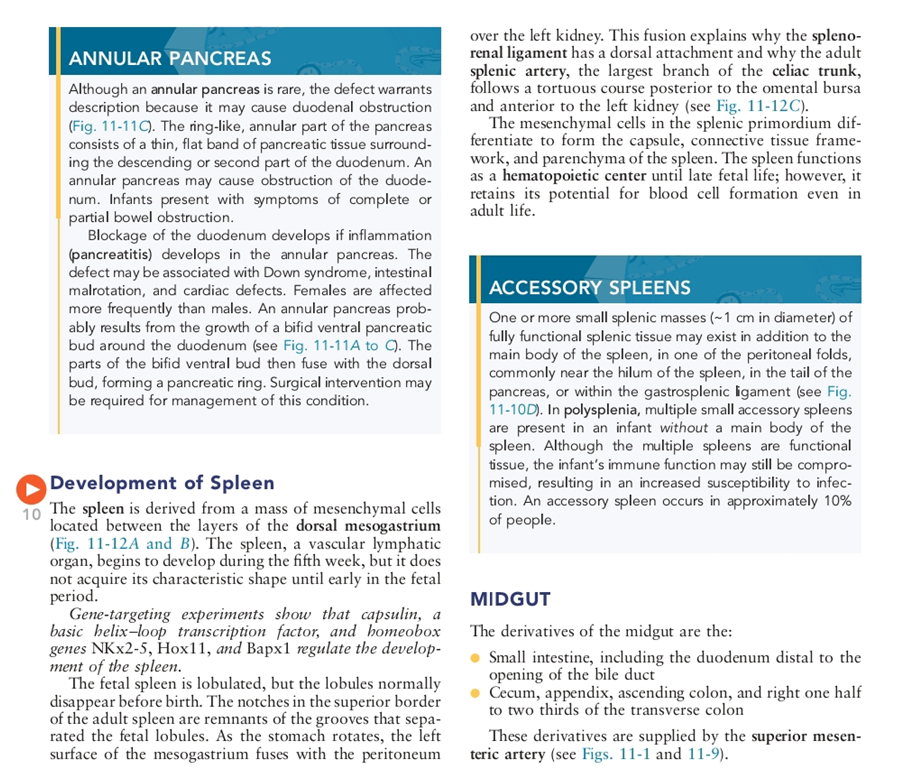
- Development of spleen (Important for Viva & MCQs)
- Accessory Spleen (Important)
- Origin of Spleen