
Prepared by:
Usman Qaisar (G13)
Ibtihal Iftikhar (G14)
Compiled by:
Muhammad Ahmad Bhatti (G14)
Recommended Book:
- Guyton and Hall Textbook of Medical Physiology 14th Edition (Chapter numbers are mentioned according to this edition)
SPECIAL SENSES
Chapter 50:
HNSS-P-001:
- Read application of refractive principles to lenses
- Refractive power in diopters formula
- Fig 50.9 important MCQ
- Read Optics of Eye
- Emmetropia (important)
- Hyperopia complete
- Myopia complete
- Astigmatism (important)
- Give a read to correction of optical abnormalities with contact lenses
- Cataracts (important)
- Definition and concept of Visual Acuity
HNSS-P-002:
- Treatment of refractive errors (with lenses)
HNSS-P-003:
- Fluid system concept
- Outflow of aqueous humor, Fig 50.18 and 50.20 (very important, proff MCQ)
- Intraocular pressure normal value (important) + it’s regulation
- Fig 50.21
HNSS-P-004:
- Glaucoma (open + closed angle ) important, from Google or lectures
Chapter 51:
HNSS-P-005:
- Retina layers (vvv important MCQ) with fig 51.1
- Fovea of retina (important) + optic disc
- Rods and cones structure + fig 51.3 (vvv important)
- Pigment layers of retina (melanin + vitamin A) important
- Retinal blood supply + retinal detachment (important)
- Visual pathway from Cones and Rods to Ganglion cells on page 647 + fig 51.12
- Investigations for retinal diseases from Google
HNSS-P-006:
- Visual cycle (important) + fig 51.5 + activated rhodopsin
- Role of vitamin A + night blindness (scenario based MCQ)
- Excitation of rods + fig 51.6 + fig 51.7
- Do make a concept of hyperpolarization + photo transduction
- Read to excitation cascade
HNSS-P-007:
- Light and Dark adaptation + Fig 51.9 (Cones adapt faster but to a lesser degree)
- Other Mechanisms
- Diseases from Google or lectures
HNSS-P-008:
- Read Tricolor Mechanism
- Do definitions of protonope + deuteranope + tritonope (important MCQ)
- Neural functional layer of retina (important cell types)
- Visual pathway + fig 51.12
- Make a concept of how signals transmitted through electronic conduction not by action potential (important viva question)
- Lateral inhibition (important MCQ)
Chapter 52:
HNSS-P-009:
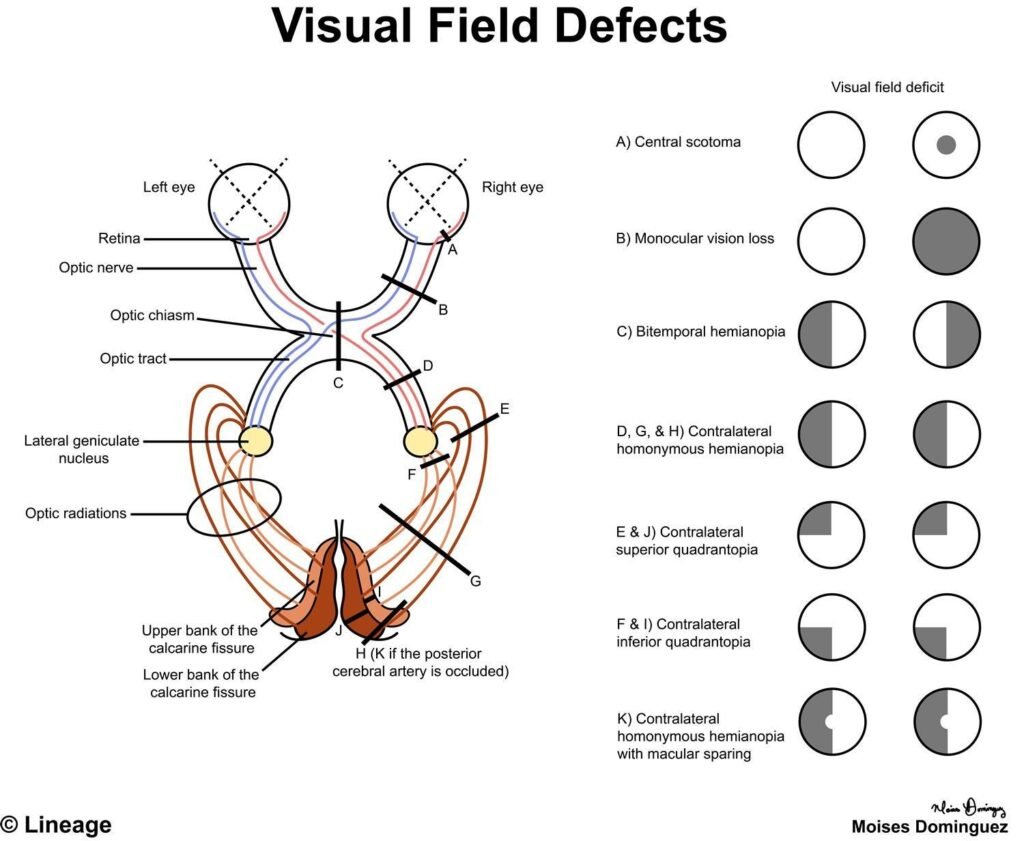
- Visual pathway (vvvvv important for MCQs) + visual fibers going to 5 older areas of brain (page 653 only)
- Primary + secondary visvual Cortex fig 52.2 + fig 52.3 only till before Layers
- Effect of removing primary visual cortex in purple box (important)
- Abnormalities of visual pathway from chart below (vvv important scenario based MCQ)
HNSS-P-010:
- Physiological blind spot (important MCQ) under Fields of Vision
- Scotoma
HNSS-P-011:
- Abnormalities of visual field (same as above + retinitis pigmentosa)
HNSS-P-012:
- Eye Movements and Their Control complete (scenario based MCQs)
HNSS-P-013:
- Strabismus (important) + fig 52.10
HNSS-P-014:
- Mechanism of accomodation (Ch 50)
- Parasympathetic control of accomodation (Ch 50)
- Presbyopia (important, Ch 50)
- Control of accomodation (Ch 52)
HNSS-P-015:
- Pupillary light reflex
- Pupillary reflexes in CNS diseases (Edinger Westphal nucleus) + (Argyll Robertson pupil) (scenario based MCQs)
- Horner syndrome
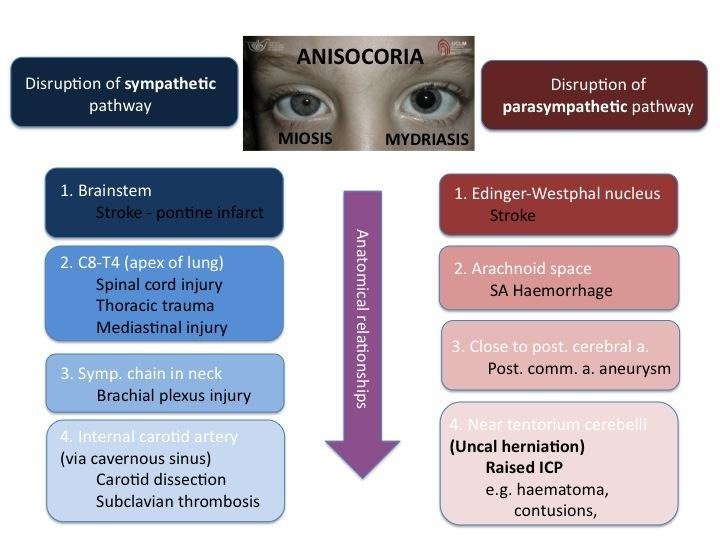
- Differential diagnosis of anisocoria (picture shared below)
Chapter 53:
HNSS-P-016:
- 53.1 (important) + do a detailed read for better understanding
- Impedence matching (vv important MCQ)
- Attenuation reflex (vvv important MCQ scenario based)
- Otomycosis and Impacted ear wax from Patho or Google
HNSS-P-017:
- Read of functional anatomy of cochlea
- Fig 53.2 and 53.3 (important for MCQs)
- Basilar membrane concept
- Transmission of sound waves in cochlea + vibration patterns
HNSS-P-018:
- Function of organ of corti fig 53.6
- Excitation of hair cells (important)
- Transmission of auditory signal + fig 53.7 (important MCQ)
- Endocochlear potential (important MCQ)
HNSS-P-019:
- Normal rage of hearing
- Place principal and Volley’s principal (common MCQ especially ranges at which they apply)
HNSS-P-020:
- Determination of loudness of sound
HNSS-P-021:
- Auditory nervous pathway + fig 53.9 (must know the order for MCQs)
- Types of deafness in purple box (important scenario based MCQ)
Chapter 54:
HNSS-P-022:
- Primary taste sensations (names + how it produce)
- Taste blindness (substance used to test for it)
- Read taste buds and their function
- Location of taste buds + fig 54.1
HNSS-P-023:
- Mechanism of stimulation of taste buds
- Transmission of taste signals + fig 54.2 (vvvv important)
HNSS-P-024:
- Definition of aguesia, hypoguesia, hyperguesia, dysgeusia (important MCQ)
HNSS-P-025:
- Taste preference and aversion
HNSS-P-026:
- Olfactory membrane + fig 54.3 (read)
- Stimulation of olfactory cells
- Action potential in olfactory cells
- Rapid adaptation
- Primary sensations of smell (important viva question)
- Transmission of smell signals , older and newer olfactory pathways (vvv important MCQ)
HNSS-P-027:
From Patho or Google.
- Rhinitis
- Difference between viral and allergic rhinitis