
Prepared by:
Asma Shafique (G15)
Compiled by:
Muhammad Ahmed Bhatti (G14)
Recommended Book:
- Guyton and Hall Textbook of Medical Physiology 14th Edition (Chapter numbers are mentioned according to this edition)
Reference Books:
- Jaypee Essentials of Medical Physiology 6th Edition
Recommended lectures:
- Medical gateway
- Byte sized med
CARDIOVASCULAR SYSTEM
THE HEART
Chapter 9:
(CV-P-001 and 002)
- Complete chapter.
- Fig 9.5, 9.6, 9.7, 9.8(Imp)
- Physiological anatomy of cardiac muscles
- Importance of intercalated disc
- Properties of cardiac muscles
- Phases of action potential of ventricle
- Phases of action potential of SA node
- Mechanism of self excitation of SA node
- Refractory period with types and duration (from any short book)
- Excitation contraction coupling mechanism
- Pressure and volume changes in left ventricle during cardiac cycle
- Cardiac cycle (most imp) complete (phases which are systole and diastole with events occurring in these phases)
- Relationship of cardiac cycle with ECG and heart sounds
- Atrial pressure waves in relation to cardiac cycle (in blue box)(imp for viva)
- Aortic pressure curve (phases) with dicrotic notch or incisura (imp for viva) (from AI)
- Definitions and normal values of cardiac output, stroke volume, end diastolic volume, and end systolic volume.
- Frank starling mechanism( imp)
- Autonomic regulation of heart
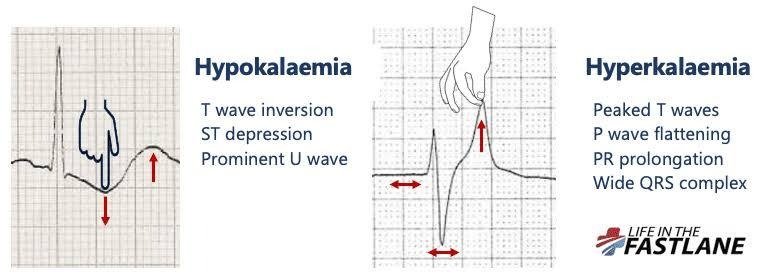
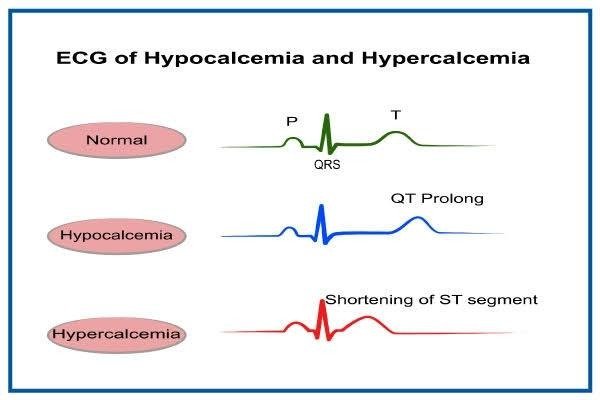
- Effect of calcium, potassium and temperature on heart
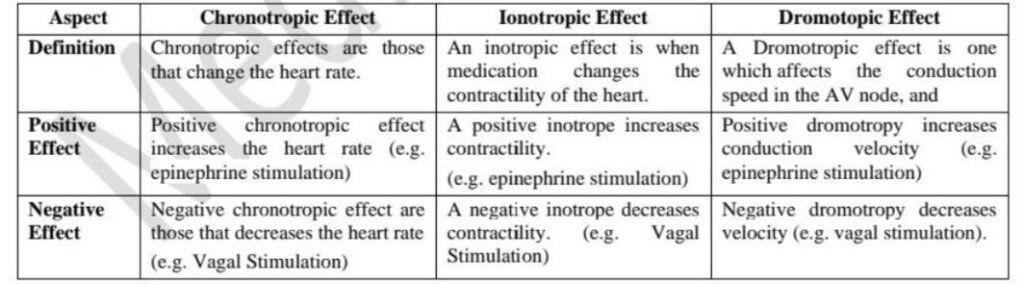
- Definitions of chronotropic, bromotropic, dromotropic, and ionotropic effects. (Given below)
- Location of adrenergic and cholinergic receptors in heart
(Adrenergic receptors are located in atria and ventricles
Cholinergic receptors are found in atria, especially SA node)
- Receptors present in coronary arterioles (adenosine receptors present in coronary arterioles, help in regulating blood flow)
- Sympathetic and parasympathetic effects.
Chapter 10:
(CV-P- 003, Ectopic Pacemaker)
- Read the chapter thoroughly and mark the mcq points.
- fig 10.2 and 10.4
- Conducting system of heart
- AV nodal delay with significance (imp)
- Control of excitation and conduction in heart (ectopic pacemaker)
- Why is the SA node considered the heart’s pacemaker?
Chapter 11:
(CV-P-004)
(Read whole chapter for concept)
- Normal ECG labelling, characteristics and time intervals
(vv imp for MCQs and Ospe as there is a separate station for ECG in Ospe)
- Memorize name, placements and polarity of leads.
- Einthoven’s law (v imp) and Einthoven’s triangle .
Chapter 12:
(CV-P-004)
(Read whole chapter for concept)
- Fig 12.2 and 12.3
- Mean electrical axis.
- Physiological basis of upright T wave in normal ECG
- Current of injury, including location and significance of J point (imp)
- ECG changes in angina pectoris and myocardial infarction
(must do 4-5 changes )(imp)(from any short book or Al)
- T wave abnormalities (v important)
- Physiological and pathological causes of right and left deviation of axis of heart
- Do the flowchart given below( can be done from AI)
Effect of electrolytes:
(CV-P-005)
Chapter 13:
(CV-P-006)
- Most important chapter.
- Complete except paroxysmal tachycardia
- AV block, ventricular fibrillation (v.v.imp)
- Also compare fibrillation and flutter
- Should be able to recognize ECGs
(ECG changes are given and you have to identify the associated disorder
from the given options)
CIRCULATION
Chapter 14, 15, 16:
(CV-P-007 and 008)
- From Firdaus
- Starling forces and Reynold’s number (with significance) are important
- Functional parts of circulation
- Pressures in systemic and pulmonary circulation
- Types of Blood Flow
Chapter 17:
(CV-P-009)
- Complete (Guyton)
Chapter 18:
(CV-P-010 and 011)
- From Guyton (v.imp)
- Do all reflexes and make flow charts of them
- Figure 18.10 (vv imp.)
Chapter 19:
(CV-P-012)
(You may read the whole chapter if you want,
but only three topics are included in your LOs)
- MEMORIZE three flowcharts: fig 19.6, fig 19.9, fig 19.12 (imp)
Chapter 20:
(CV-P-013)
- Normal values
- Cardiac index
- Hyper and hypo-effective heart
- Nervous control
- Physiological and pathologically high and low CO.
- Venous return (read and focus on headings)
- Different methods for measuring cardiac output ( only names and fick’s oxygen method)
Chapter 21:
(CV-P-014 and 015)
(Can do from Firdous)
- Regulation of skeletal muscle blood pressure
- Physiological anatomy of coronary circulation
- Regulation of coronary blood flow
- Angina pectoris, myocardial infarction and subendocardial infarction.
Chapter 23:
- Heart sounds (v.v.v.imp) Table Given
- Full chapter is v important
- Should be able to recognize phonocardiograms.
Chapter 24:
- Most important
- Scenario based MCQS
- Do it complete from Guyton
Note: Watch Dr. Najeeb ECG lectures for UNDERSTANDING, however nothing from them will be asked in exam, it is only to understand how characteristic ECG is produced