Medico Guides 4th Block (Module No 06) Biochemistry Guidelines

Prepared by:

                     Hanzala Masood (G14)

Compiled by:

                     Hafiz Muhammad Umair Noor (G12)

  • Lippincott Illustrated Reviews: Biochemistry 8th Edition (Chapter numbers are mentioned according to this edition)
  • Satyanarayana Biochemistry 6th Edition
  • Medicnetic or Medico Express block 4

NOTE:

CARBOHYDRATE METABOLISM

GIT-B-001

➡️ For this LO, there are multiple sources. You can cover these topics from Lecture slides, Medicnetic/medico express or Mushtaq Biochemistry. Same topics are also given in Hashmi’s biochemistry book

 Saliva:

  • Saliva (composition and importance) v.imp
  • Xerostomia v.v.imp

Gastric juice:

  • Gastric juice (composition and importance)
  • Mechanism of HCL secretion v.imp (For this you have to understand and memorize its diagram) this diagram also given in Guyton (Chp 65 fig 65.6 pg 812)
  • Achlorhydria (imp) and Gastric ulcer
  • Alkaline Tide (v imp IT WAS OUR PROFF Q so prepare it completely)

Pancreatic juice & Bile:

  • Pancreatic juice and bile (composition and importance)
  • Pancreatitis, cystic fibrosis and cholelithiasis.

Digestion and absorption of dietary carbohydrates:

➡️ From Lippincott chapter 7 pg no 95 till end.

  • Flowcharts 7.9,7.10 & 7.11 v.imp
  • Lactose intolerance and Sucrase isomaltase deficiency (v.v.imp)

GIT-B-002

➡️ From Lippincott Chapter 8 topics: Glucose Transport into The Cells

  • Table 8.1 (v.imp)

GIT-B-003

➡️ Not an important topic OR You can cover this topic from medicnetic/medico express.

GIT-B-004

➡️ From Lippincott Chapter 8: Glycolysis

  • Don’t skip even a single thing, entire chapter is v.imp so cover it entirely.
  • Steps , All Regulations , Arsenic poisoning (v.v.imp), Pyruvate kinase deficiency, Pyruvate reduction to lactate, Energy yield, Hormonal regulation , Alternate fates of pyruvate.

GIT-B-005

➡️ From Lippincott Chapter 9: TCA Cycle

  • Cover entire chapter as whole chapter is v.imp.
  • Everything is important:
  • Actyl CoA production
  • Pdh complex , it’s regulation including fig 9.2 (v.v.imp)
  • Deficiency of thymine and Leigh syndrome boxes
  •  Arsenic poisoning ( v.v.imp)
  • Energy produced ( v.imp)
  • Cycle regulation ( v.imp)

GIT-B-006 & 007

➡️ From Lippincott Chapter 10: Gluconeogenesis

  • Cover entire chapter as whole chapter is important.
  • Also in this chapter, everything is important:
    • Substrates (Glycerol, lactate and Amino acids)
    • Fig 6.2 (Cori Cycle) v.v.imp
    • Reactions ( all v.imp)
    • Must remember all enzymes, regulations, transports of molecules included in steps of Gluconeogenesis.
    • Fig 10.7 ( v.imp)
    • Regulation
    • By glucagon (v.imp )
    • By substrate availability, acetyl CoA and AMP ( imp)
    • Glucose Alanine cycle (v.imp) from LIPPINCOTT CHAPTER 19 FIG 19.3

GIT-B-008

➡️ From Lippincott Chapter 10: Glycogen Metabolism

  • Cover entire chapter as whole chapter is important
  • Everything also in this chapter is important:
    • Storage and function (read)
    • Synthesis (Glycogenesis)
    • For steps, add points from text to figs of Lippincott and then mainly remember those points and especially fig
    • Fig 11.5 (v.imp)
    • Degradation (Glycogenolysis)
    • For this, focus on figs and points in the same manner as synthesis.
    • Regulation (complete and focus on figs)
    • Glycogen storage diseases: (Very Important)
      • One of the most important topics in biochem block 4.
      • Examiners always focus this topic for Qs
      • Learn / Cram them completely. Their Types, Numbers, Other names, Enzyme deficient, Signs and symptoms
      • Table 11.1 for Cori , Andersen , Hers and Tarui diseases
      • Points from fig 11.8 for Von Gierke , Pompe and McArdle diseases
      • Also must remember points that are specific for a particular disease eg cardiomegaly occurs in Pompe disease
      • Qs From this topic are mostly given in the form of scenarios and anything can be asked so try to practice their mcqs form any source especially scenarios)
      • Make nemonics or use other ways but must remember them completely.

GIT-B-009

 ➡️ From Lippincott Chapter 13: Pentose Phosphate Pathway and NADPH

  • Complete chapter is important
  • All Topics are equally significant:
    • Irreversible oxidative reactions imp)
    • Fig 13.2 (v.v.imp)
    • Reversible oxidative reactions
    • Fig 13.3 imp
    • Uses of NADPH ( v.v.imp)
    • Cover all uses completely
    • Fig 13.8 v.imp
    • G6PD deficiency and associated hemolytic anemia (v.v.imp)
    • Clinical Application 13.1 (imp)
    • Fig 13.10 v.imp
    • Precipitating factors (all v.imp)
    • Gene variants

GIT-B-010

 ➡️ Sorbitol Pathway from Lippincott Chapter 12: Mono and Disaccharide Metabolism

  • Topic: Glucose conversion to fructose via sorbitol.
    • Complete text along with its osmotic effects in diabetic patients and fig 12.4 (v.imp)
  • Uronic Acid Pathway from Satya Chapter 13 fig 13.25 (synthesis of glucuronic acid) complete

GIT-B-011

➡️ Ethanol Metabolism from Lippincott Chapter 23 pg 352

  • Start from the heading ALCOHOL RELATED HYPOGLYCEMIA
  • Complete text along fig 23.15 and BLUE BOX: How chronic alcohol consumption causes Fatty liver ( v.imp) OUR COLLEGE BLOCK 4 SEQ.

GIT-B-012 & 013

➡️ From Lippincott Chapter 6: Bioenergetics and Oxidative Phosphorylation

  • Complete the chapter in the following way:
    • Skip the starting topics Free energy and free energy change
    • Read and understand the topic ATP as energy carrier ( a good read)
      • Electron transport chain (ETC) it’s
        • Components
        • Organization
        • Reactions (read and understand the text and shortlist important points along with fig 6.8. Fig 6.8 is v.imp)
    • Site specific inhibitors (v.imp) from fig 6.10
    • Skip energy released
    • PHOSPHORYLATION OF ADP TO ATP (whole topic is v.imp)
    • Chemosmotic hypothesis along with ATP synthase it’s function and it’s diagram from fig 6.14 v.imp
    • Coupling
    • Oligomycin, Uncoupling proteins & synthetic Uncouplers (v.v.imp)
    • How Aspirin at high doses causes fever? ( V.v.imp given in synthetic Uncouplers) (College Block 4 SEQ.)
    • Membrane transport systems
      • Glycerol 3 Phosphate Shuttle
      • Malate Aspartate shuttle
      • From Fig 6.17 (v.imp)
    • Inherited defects in Oxidative phosphorylation (text + table 6.1)
    • Regarding TABLE 6.1: SEQ was asked from this table in proff 2023 but nothing significant was asked at our time (But try to memorize it to some extent to be on safe side)
    • Mitochondria and apoptosis (v.imp)

GIT-B-014 to 20

  • All of these LOS can be covered by doing from medicnetic or medico express
  • All these topics are scattered in different books
  • It’s preferable to do from medicnetic or medico express because they follow LOS and book wording and their content will be enough Insha Allah.
  • Macro and Micronutrients
  • Balanced diet and its importance
  • BMR complete
  • BMI complete
  • Malnutrition including protein energy malnutrition (Kwashiorkor and Marasmus) their symptoms difference features management (v.v.imp) Block 4 SEQ
  • Upper body and lower body obesity

NOTE:

Medico Guides 4th Block Minors Guidelines

Prepared by:

                                     Ahsan Ali (G14)

Compiled by:

                                Rukhsar Uns (G14)

PATHOLOGY

  • Robbins Pathology 11th Edition
  • Fundamentals of Pathology (Pathoma)
  • Guyton and Hall Textbook of Medical Physiology 15th Edition Chapter 67

Additional/compliment resources:

  • Medico Express/Medicnetic
  • Chapter 2 (past papers)

GIT-Ph-001: Gastritis

  • Define gastritis (inflammation of stomach mucosa)
  • Types of gastritis: acute and chronic (type A: H. pylori  and type B: autoimmune)
  • Morphology of gastritis (imp) (diagram 15.13 and 15.14 mediums Robbins)
  • Acute vs chronic gastritis features i.e morphology (vvimp) and their causes (table 15.2 medium Robbins)

Peptic Ulcer Disease:

  • Causes: H. pylori, NSAIDS, smoking, stress
  • Sites: stomach, deodenum
  • Pathogenesis: aggressive factors, protecting factors
  • Morphology: “Punched-Out Lesion”
  • H. Pylori role in ulcers

Diarrhea:

  • Causing agents: Table in chapter 2
  • Names of agents
  • Their pathogenesis
  • Their features from Medico Express
  • Should do from Medico Express

Renal stones (vv imp):

  • Types, causes, pathogenesis

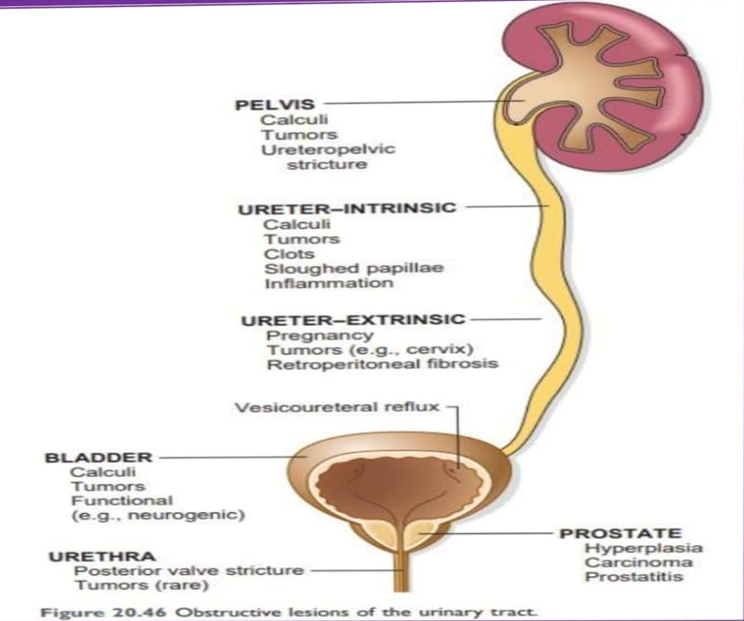
Hydronephrosis:   

  • Dilation, renal pelvis, urine flow blocked
  • Morphology (imp)

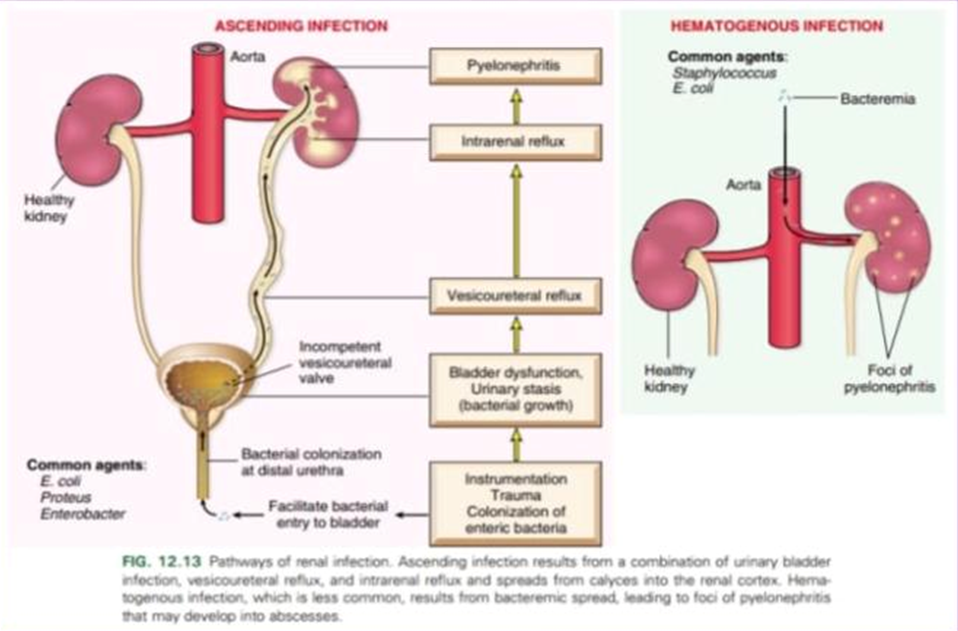
Pyelonephritis (vv imp):

  • Morphology
  • Diagram(imp):(20.24, 20.26, 20.27, 20.31) Medium Robbins
  • Causative agents(imp)
  • Clinical features

Cystitis (Bladder Inflammation):

  • Causing Agents
  • Acute vs chronic cystitis
  • Clinical features

Glomerulonephritis (imp):

  • Pathogenesis
  • Actue nephritic syndrome vs nephrotic syndrome (vvv imp)
  • Morphology: Table in chapter 2

Acute kidney Injury:

  • Morphology
  • Causes: Pre renal, intrinsic, post renal

Urinary Tract Infection:

  • Upper vs lower UTI features
  • Agents

PHARMACOLOGY

  • There are only 2 topics in this block

(You can do it from Chapter 2 or Medico Express)

  • Classify anti diarrheal drugs
  • Pharmacokinetics, mechanism of action, pharmacological effects, uses and adverse effects(Imp)
  • Do names of drugs and their mechanism of action
  • Their clinical uses and adverse effects
  • Do marked summaries of Katzung given in pdf

(You can do from Chapter 2 or Medico Express)

(Diuretics are also in last chapter of renal physiology)

You should know

  • Site of action
  • Mechanism of action
  • Adverse effects
  • Effects on K+ and Calcium levels and pH
  • Adverse effects of thaizaide diuretics
  • Do summary table of Katzung from pdf shared

Medico Guides 10th Block Special Pathology Guidelines

Prepared by:

                Soila Ansar (G12)

                Shahr Bano Sayal (G12)

Compiled by:

                  Talha Saleem (G12)

  • Medium Robbins Latest Edition (Chapter numbers are mentioned according to this edition)
  • Pathoma Fundamentals of Pathology
  • Essentials of Special Pathology by MBBS Cafeteria

Overview:

  • The most important subject in the entire MBBS is pathology so prepare it thoroughly and don’t go after short cuts for this subject. It is always the best way to prepare not from a single book or source and try to give at least a read to more than one source.
  • Sources for pathology which I used were; Medium Robbins, pathoma notes and its lectures, Dr Najeeb’s lectures, MBBS cafeteria book.

Medium Robbins: It should be your main book if you want to have a clear and detailed understanding of things. The problem with this book is that it looks exhausting and boring so to overcome this you first need to tell yourself that it’s not difficult and you can easily do it for enough times to kick off the fear of this book then for the first time, don’t try to remember each line of it instead just try to understand what it’s saying and flow of information like try to remember that which aspects have been discussed. And the imp thing is to highlight or underline the imp 2 or 3 lines of each paragraph. For the second time, again read the entire text and then after that you’ll just need to read the highlighted ones. And one other thing, whenever you read this book, always do histology diagrams and foot notes, I said always, it will help you a lot in remembering morphologies.

Pathoma: When you decide to prepare for a certain topic, first take its lectures. It will provide you an overview of the topic. Further, many MCQ points are typical of this book which can’t be solved even after learning Robbins. This book doesn’t give a comprehensive concept but a short note of every related and less imp thing, so in this way you’d be able to have heard unimportant things which rarely come in exams.

Dr Najeeb’s lectures: I personally like the way of teaching of this man but if you don’t find it suitable according to your mood then it’s fine. You can take any other lectures or no lectures at all, whatever you like. But, after taking his lectures, I always felt that it makes you stand out among others when it comes to having a deep concept of things.

MBBS Cafeteria: As far as this book is concerned, it has no value at all once you have prepared a topic from pathoma and robbins. You can use this book in an emergency situation (except PROFF) when you don’t have time to prepare from a good source and you have no other option.

GASTROINTESTINAL TRACT

It’s the most important topic of pathology. First take pathoma lectures, then do the following topics from medium Robbins:

Oral Cavity:

  • Aphthous ulcers, oral candidiasis (only read)
  • Leukoplakia and Erythroplakia (imp)
  • Squamous cell CA (v.imp) risk factors, pathogenesis, morphology
  • Salivary gland neoplasms (imp) classification, morphologies

Esophagus:

  • Atresia, fistula, stenosis, ectopia (only read)
  • Achalasia* (imp) triad, 1° & 2°, causes
  • Esophageal varices (imp)
  • Esophagitis (v.imp) Mallory Weiss tears, Boerhaave syn, chemical, infectious
  • Reflux esophagitis (imp)
  • Eosinophilic esophagitis (read)
  • Barret esophagus (imp) morphology
  • Esophageal CA (v.imp) adenocarcinoma (RF, morphology) SCC (RF, pathogenesis, morphology)

Stomach:

  • Gastropathy vs gastritis, pathogenesis, curling, Cushing and stress ulcers
  • Chronic gastritis (v.imp) 3 main causes, H. pylori (pathogenesis, morphology), autoimmune (CF, pathogenesis, morphology), difference table
  • PUD (v.imp) pathogenesis, morphology, CF
  • Dysplasia, gastric polyps (read)
  • Gastric adenocarcinoma (v.imp) pathogenesis, morphology, CF 
  • Lymphoma
  • Carcinoid tumor(imp) pathogenesis, morphology, CF
  • GIST (read) gene, morphology

Small & Large Intestine:

  • Intestinal obstruction (4 causes)
  • Intussusception, Hirschsprung disease (v.imp)
  • Hernia, Ischemic bowel disease (pathogenesis, CF), hemorrhoids (read)
  • Diarrhea (SOME 4 categories), malabsorptive (4 types+ table), cystic fibrosis
  • Celiac disease (v.imp) pathogenesis, fig, morphology, CF
  • Lactase def, abetalipoproteinemia(read)
  • Microscopic colitis(imp)
  • Infectious enterocolitis (table+summary)

HEPATOBILIARY SYSTEM

  • Do this topic from medium robbins with Ayesha Batool’s shortlist (because it’s very important topic) and morphology from MBBS Cafeteria
  • Or if you have no time then use MBBS Cafeteria bcz morphology is mentioned in cafeteria book.
  • Table 16.1 (vvv imp)
  • General features of liver disease (hepatocyte injury, confluent necrosis and bridging necrosis)
  • Liver failure types (imp)
  • Acute liver failure (flow chart bna lein) morphology from cafeteria
  • chronic liver failure causes and complications (v imp) (morphology from cafeteria)
  • Acute on chronic causes (v imp)
  • Summary of liver failure (v imp)
  • Viral hepatitis table 16.2 (v imp)
  • Figure 16.2(seq) (imp)
  • Figure 16.9 (v imp)
  • Figure 16.10 (v imp)
  • Figure 16.12 (v imp)
  • Clinicopathologic syndromes (read it)
  • Acute asymptomatic
  • Acute symptomatic
  • Fulminant failure (v imp)
  • Morphology from cafeteria
  • Figure 16.13 (v imp)
  • Autoimmune hepatitis with morphology (v imp)
  • Table 16.3 (read it)
  • Alcoholic liver failure (imp most) with morphology
  • Non-Alcoholic liver disease with morphology (v imp)
  • Fig 16.19
  • Wilson disease (imp)
  • Alpha-1 antitrypsin deficiency (v imp)
  • Table 16.4 (vv imp)
  • Autoimmune cholangiopathies (v imp) (Both types are most important)
  • Table 16.5 (imp)
  • Hepatocellular carcinoma (v imp)
  • With morphology
  • Gallstones, types, features (v imp)
  • Table 16.6 (vv imp)
  • Cholecystitis
  • Acute calculous cholecystitis (imp)
  • Acute Acalculous cholecystitis (imp)
  • Annular pancreas
  • Acute pancreatitis (imp) with morphology
  • Table 17.1 (imp)
  • Figure 17.1 (v imp)
  • Chronic pancreatitis with morphology (imp)
  • Pancreatic carcinoma (read it)